
Ultrasonics · 3 min read
Ultrasonic Cleaner Circuit Design: Frequency, Power and Control
Driving piezoelectric transducers efficiently means respecting resonance, managing power and designing control that adapts to the tank.
NANOSOFT Engineering Insights
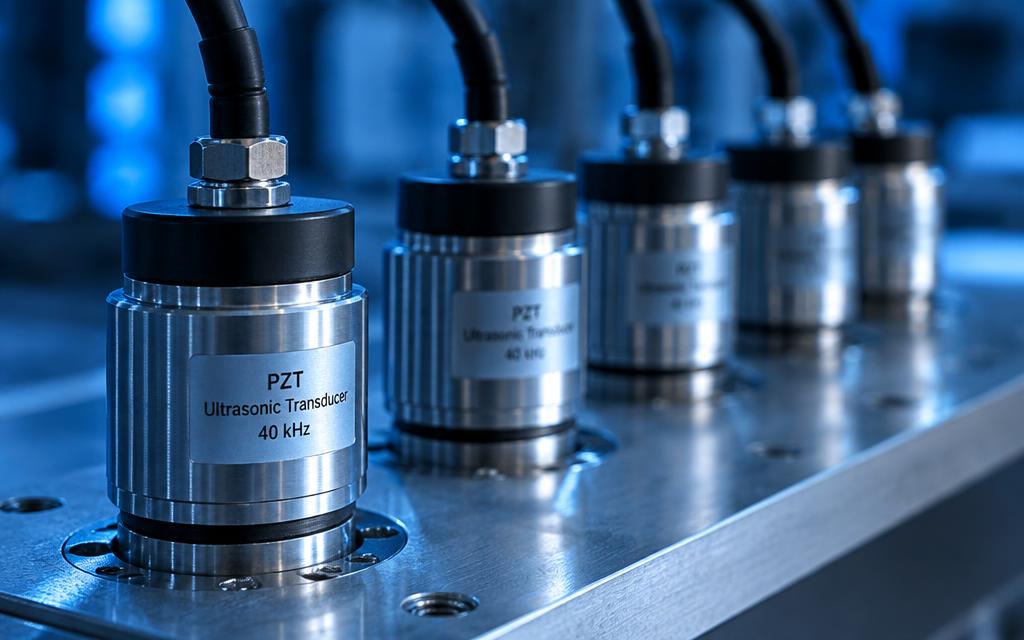
The load is not a resistor
A piezoelectric transducer bonded to a tank behaves like a resonant circuit with a strong capacitive component. Its impedance changes sharply around resonance and shifts with temperature, liquid level and load. The generator must cope with all of this.
Choosing the operating frequency
Lower frequencies (for example around 25–28 kHz) produce larger cavitation bubbles and more aggressive cleaning. Higher frequencies (for example 40 kHz and above) produce smaller bubbles and gentler, more uniform action suited to delicate parts. The transducer is built for a specific frequency, and the electronics must match it.
Power stage topology
Half-bridge and full-bridge switching stages are common. A transformer steps up voltage and provides isolation, while a matching inductor compensates the transducer capacitance so that the stage sees a more resistive load near resonance.
- Device selection for voltage, current and switching losses
- Dead-time control to avoid shoot-through
- Snubbers and layout to control ringing
Frequency tracking and sweep
Tracking
Feedback from current or phase lets the controller keep the drive near resonance as conditions drift.
Sweep
Modulating the frequency over a small range reduces standing-wave hot spots and spreads cleaning action more evenly through the tank.
Control and user experience
Power level, timers, degas modes, heater control and fault indication are all firmware features. Designing them in from the start produces a coherent product rather than a power stage with controls bolted on.
Frequently asked questions
Working on something similar?
Tell us about your application and we'll respond with practical engineering next steps.
Have a custom electronics project in mind?
Share your requirements and get a structured engineering response from our team.