
Project Planning · 3 min read
How to Define Requirements for a Custom Embedded Electronics Project
Clear requirements are the cheapest engineering you will ever do. Here is a structure that works for embedded hardware projects.
NANOSOFT Engineering Insights
Why requirements matter more in hardware
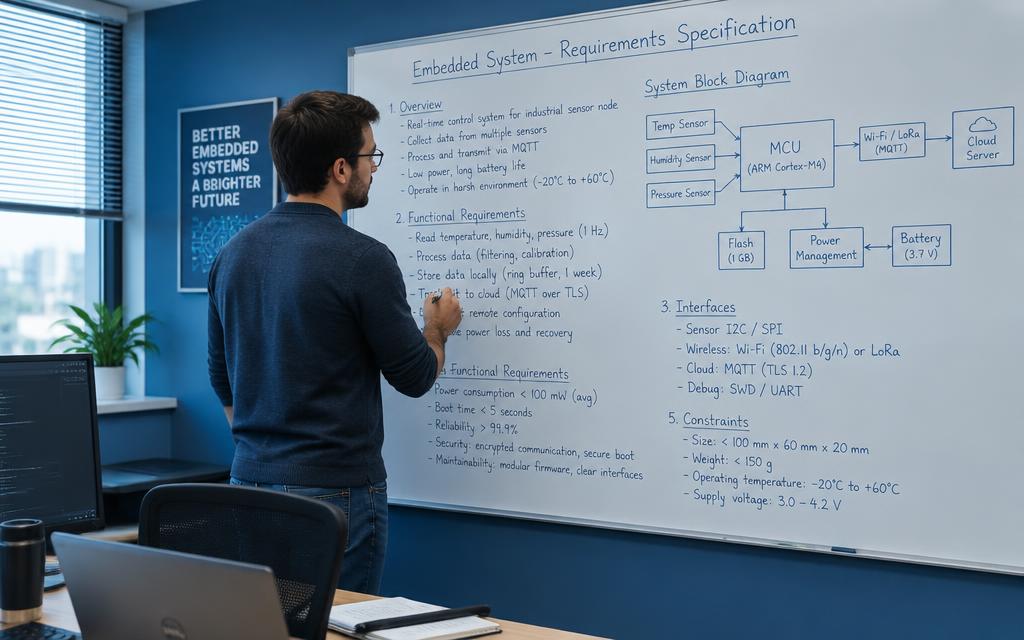
Software can be changed after release; a printed circuit board cannot. A missed interface or an underestimated temperature range can force a complete board revision. Time spent clarifying requirements up front is repaid many times over.
Start with purpose and context
Describe what the product does, who uses it and where it lives. A system context diagram — the product in the middle, everything it interacts with around it — is often the most useful single page in the whole document.
The core requirement categories
Functional
What the device must measure, control, display or communicate, and how it should respond to normal and abnormal conditions.
Interfaces
Sensors, actuators, power inputs, communication buses, connectors and user controls — with electrical levels where known.
Environmental
Operating and storage temperature, humidity, ingress protection, vibration and electrical environment.
Constraints
Size, cost targets, power budget, expected volumes, preferred suppliers and timeline.
Prioritise and make it testable
Not every requirement is equal. Label each as must, should or could. Then ask of every must: how would we verify this? If you cannot describe a test, the requirement is probably not specific enough yet.
- Replace 'fast' with a response time
- Replace 'low power' with a current or battery-life figure
- Replace 'robust' with the conditions it must survive
What to do when you do not know
It is normal not to know everything at the start. Record open questions explicitly and assign them to the feasibility stage. An honest 'to be determined' is far better than a guessed number that later becomes a constraint nobody questions.
Frequently asked questions
Working on something similar?
Tell us about your application and we'll respond with practical engineering next steps.
Have a custom electronics project in mind?
Share your requirements and get a structured engineering response from our team.